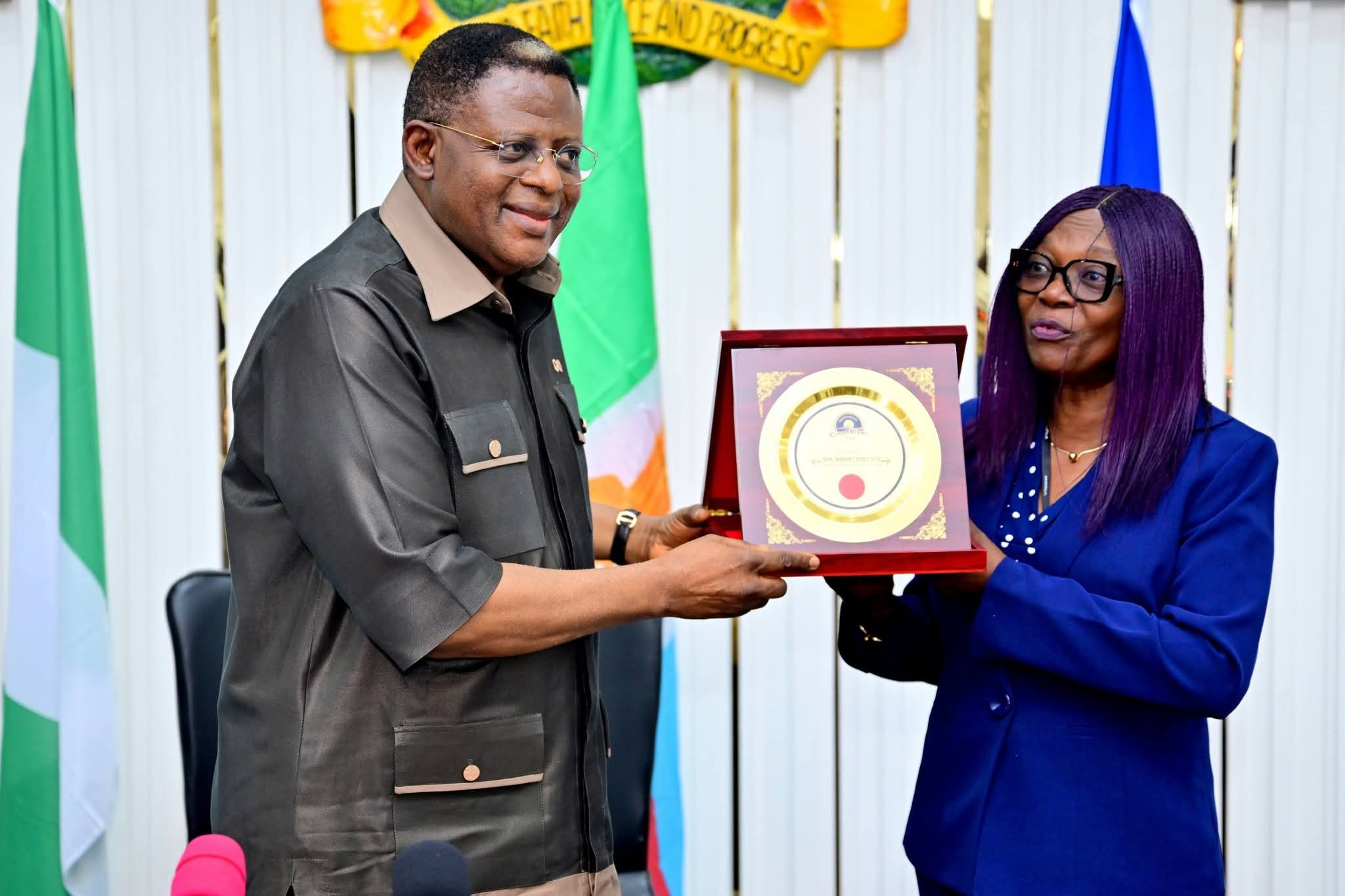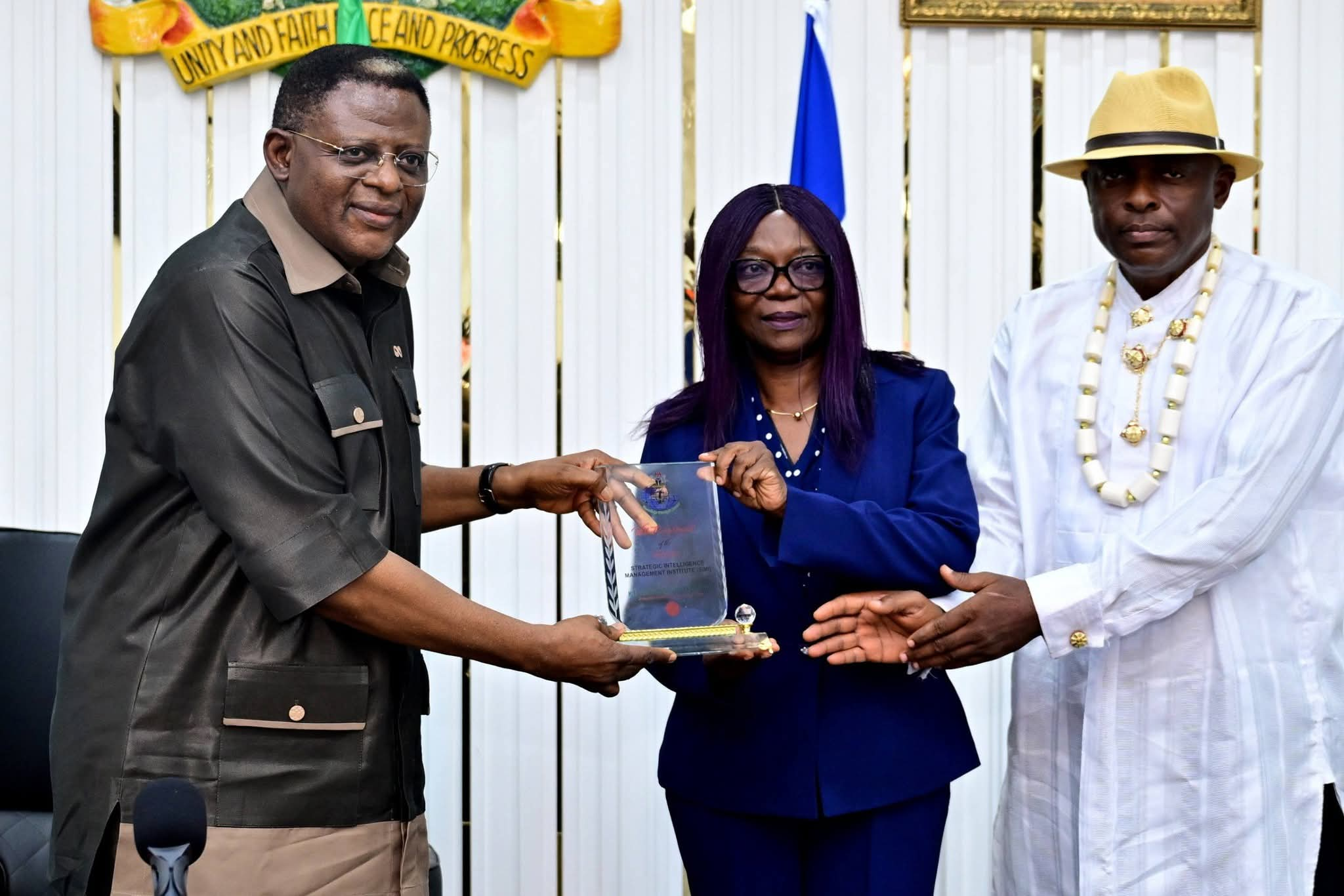

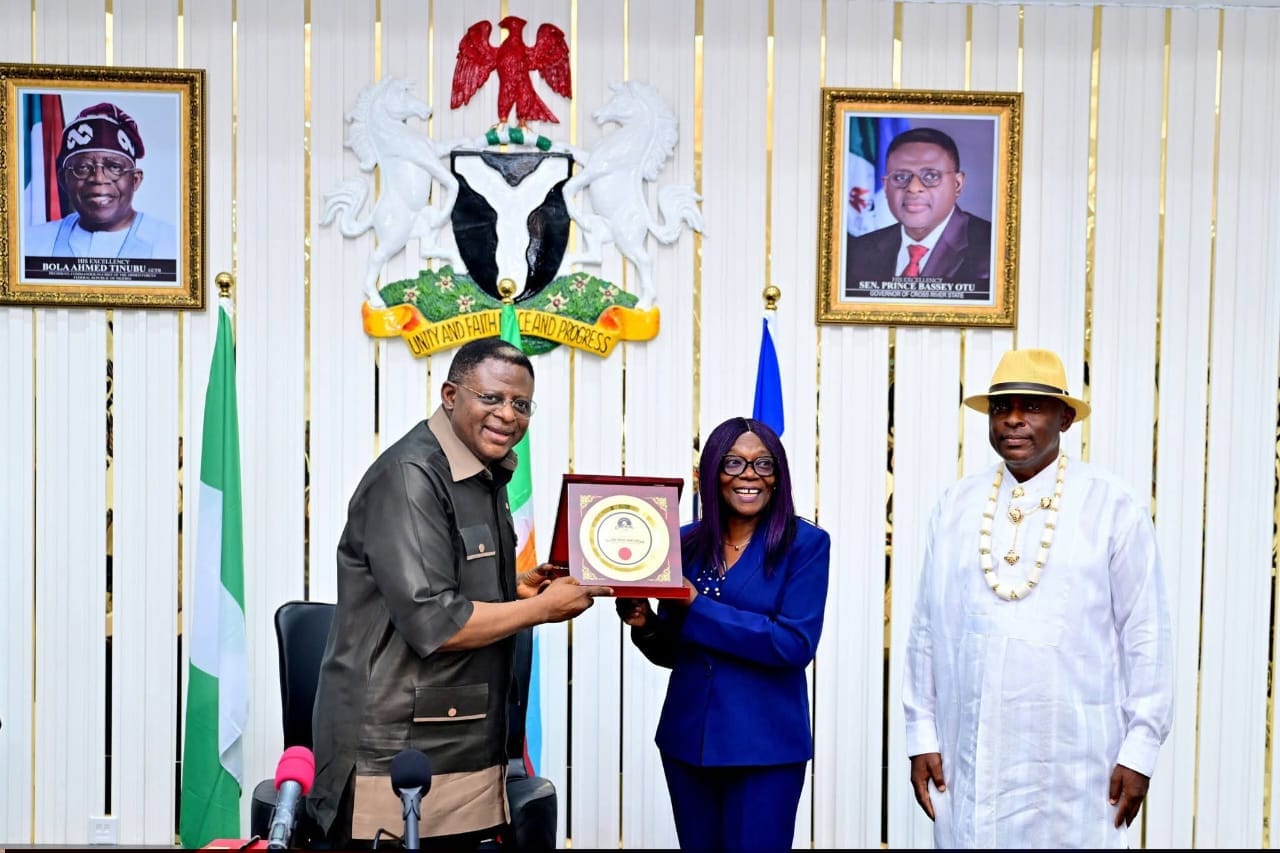
The Provost of the Strategic Intelligence Management Institute (SIMI), Ambassador Jadesohola Adesuyi, has commended the Cross River State governor, Senator Bassey Edet Otu, for his commitment to security, governance, and academic excellence, describing his leadership as a model worthy of study and emulation.
Speaking during a courtesy visit at Government House, Calabar, Adesuyi congratulated the governor on his recent conferment of a Doctor of Political Science by the University of Calabar. She noted that the honour, coming shortly after another recognition by Modibbo Adama University, “stands as a strong testament to your enduring commitment to academic excellence and the advancement of education.”
“We are indeed proud of you and wish Your Excellency many more laurels in the years ahead,” she said, setting the tone for a high-level engagement that underscored the connection between intelligence, governance, and national security.
Adesuyi explained that SIMI, also known as the Strategic IntelligenceManagement Institute Intelligence Institute, is dedicated to grooming senior public officers, particularly within the security and intelligence community, in critical thinking, risk assessment, strategic planning, and policy decision-making. According to her, “our core mandate is to build a cadre of leaders who not only understand intelligence but can effectively translate it into sound policy decisions in the national security interest.”
She emphasized the often-overlooked gap between intelligence production and utilization, noting that while intelligence agencies understand the value of the information they generate, “the end users must equally understand how to interpret and apply such intelligence within governance frameworks.” This, she said, informed the Institute’s emphasis on bridging intelligence and policy.
The Provost further disclosed that the delegation was in Cross River State on a study tour guided by the theme: “New Regional Dynamics, New Policy Responses,” with a particular focus on border security. She explained that evolving geopolitical realities in West Africa necessitate a deeper examination of Nigeria’s border management strategies.
Citing the withdrawal of Mali, Burkina Faso, and Niger from ECOWAS to form the Alliance of Sahelian States, Adesuyi noted that the development carries significant implications for Nigeria’s national security architecture. “Given our close historical and security ties, especially with the Niger Republic, these changes demand careful study and strategic response,” she said.
She commended Governor Otu’s administration for its proactive approach to security, noting that Cross River has become “a model of inter-agency collaboration and strategic prioritization of security.” According to her, “your willingness to receive us underscores your well-known commitment to proactive security governance.”
Adesuyi also assured the state government that the outcome of the Institute’s study would be shared, particularly recommendations relevant to Cross River State, while offering to design bespoke capacity-building programmes for senior officials of the state. “We stand ready to partner with your administration in strengthening institutional capacity,” she added.
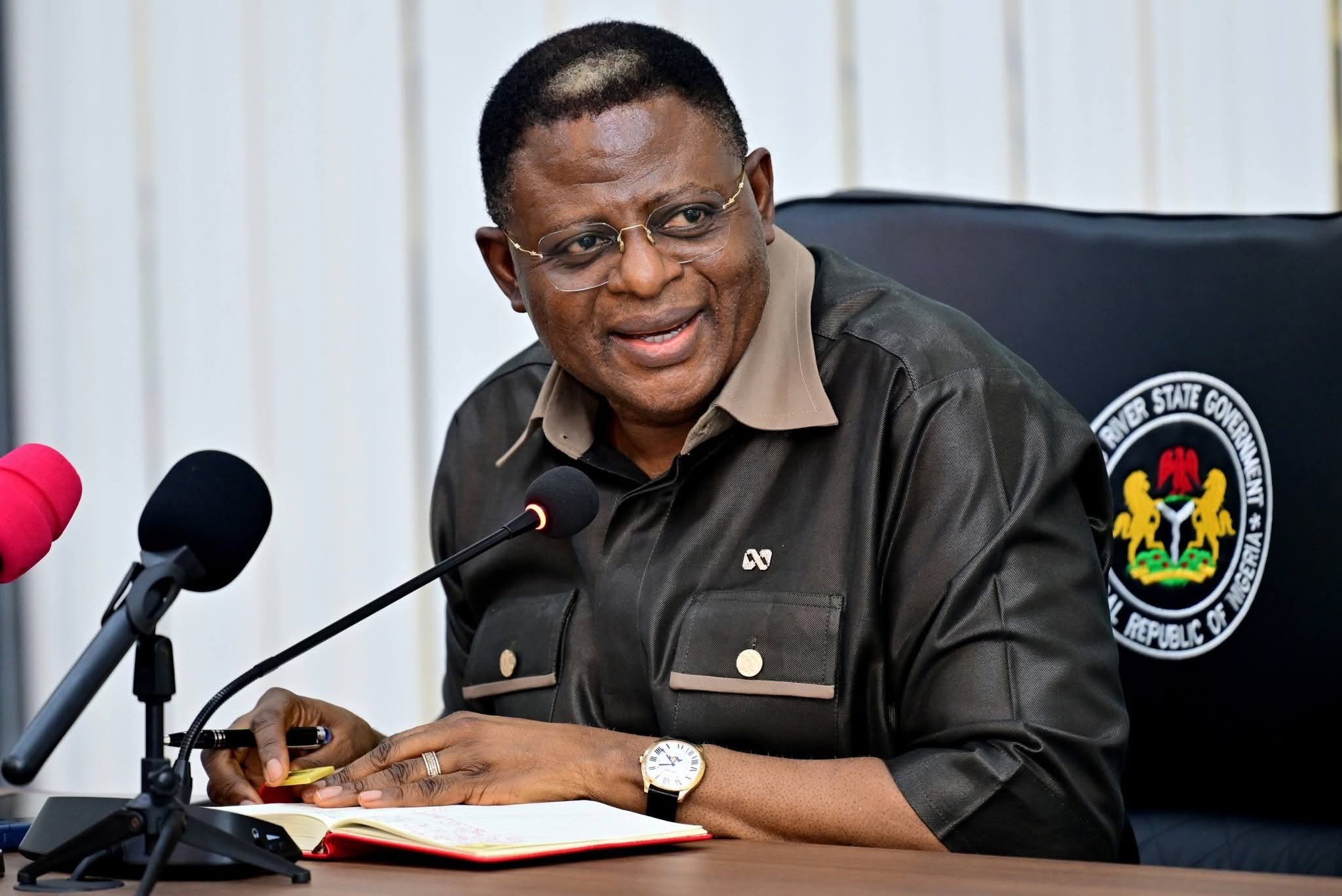
Responding, Governor Otu expressed appreciation for the visit and used the opportunity to highlight the centrality of security and energy to national development. “At its core, the connection between government responsibility and national development lies in two critical areas: security and energy,” he stated, stressing that these sectors are “not just priorities, but existential” for Nigeria.
The governor described Cross River as a strategically significant state, noting its role as a major evacuation corridor and its vast maritime boundary. “We are custodians not only of lives and property but also of territorial integrity,” he said, adding that the state shares nearly 500 kilometres of boundary with neighbouring countries and sits along a critical navigational channel.
Otu revealed that the state currently hosts between 54,000 and 60,000 refugees in cross-border locations, placing immense strain on its security architecture. “We had to independently secure our coastline and protect our people when responses from relevant authorities were not forthcoming,” he disclosed.
He recounted how insecurity previously crippled economic and social life in the state, forcing professionals, including doctors, to flee. “It was almost impossible for people to sleep. Kidnappings were rampant, and we had to act decisively to restore order,” he said, commending security agencies for their “relentless, round-the-clock efforts” in sustaining peace.
The governor, however, raised concerns over emerging threats, particularly illegal activities within ungoverned maritime territories. He disclosed that “foreign actors are engaged in continuous, unauthorized extraction of resources,” describing the situation as both economic sabotage and a grave national security risk.
“At a time when Nigeria faces a budget deficit of about ₦6 trillion, these illegal operations are generating, by conservative estimates, over $10 billion monthly,” Otu said, warning that failure to act could result in the loss of strategic coastal assets.
He also expressed concern over regional instability following shifts within ECOWAS, noting that Nigeria faces increasing security pressure due to inadequate buffers. “The implications of instability in neighbouring countries inevitably spill over into our borders,” he said, warning that the situation in parts of northern Nigeria is already alarming.
“As the saying goes, if you climb onto the back of a lion or a tiger, getting down safely becomes a challenge,” the governor remarked, adding that “the threat evolves daily and has now advanced as far as Benue.”
Governor Otu reaffirmed his administration’s commitment to security collaboration and strategic governance, while welcoming partnerships such as that offered by SIMI.