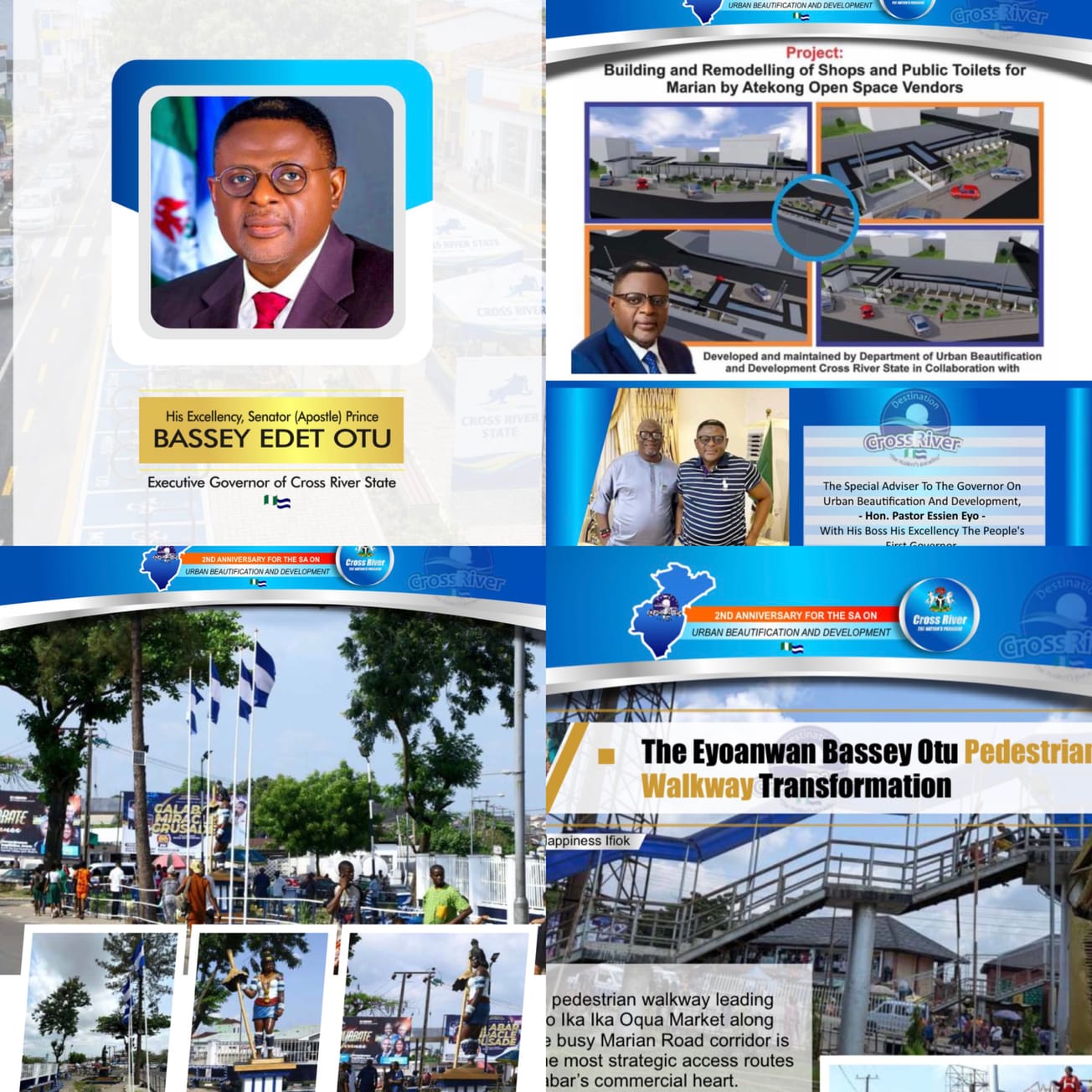
Visible Proofs of Governor Bassey Otu’s People-First Vision Through the Office of the Special Adviser on Urban Beautification and Development
Cities speak long before their people do. They communicate through the cleanliness of their streets, the orderliness of their public spaces, the beauty of their parks, and the functionality of their urban infrastructure. A well-kept city reflects a government that values its people and a citizenry that takes pride in its environment.
For decades, Calabar enjoyed global recognition as Nigeria’s cleanest city, a reputation carefully built through deliberate environmental policies, disciplined waste management, and a culture that encouraged civic responsibility. Like many growing urban centres, however, the city gradually witnessed the erosion of some of these standards as public infrastructure deteriorated, green spaces diminished, and environmental discipline weakened.
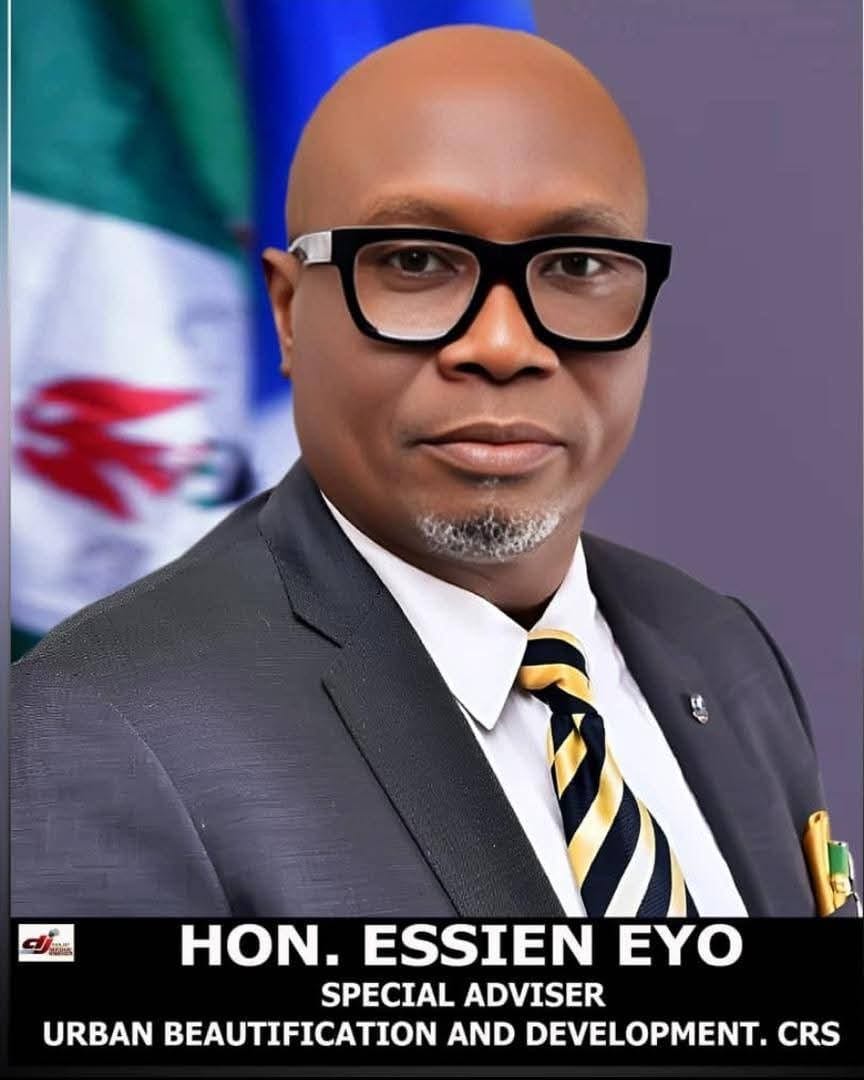
Two years into the administration of Governor Senator Prince Bassey Edet Otu, deliberate efforts are once again redefining the city’s urban landscape. Working quietly behind many of these interventions is the Office of the Special Adviser to the Governor on Urban Beautification and Development under the leadership of Hon. Pastor Essien Eyo, whose modest but impactful initiatives are steadily restoring the beauty, order and functionality of public spaces across Cross River State.
Rather than pursuing grandiose projects, the office has concentrated on practical interventions that improve daily life, enhance environmental sustainability, preserve cultural heritage and encourage civic responsibility.
Building Progress Through Collaboration
Urban beautification extends beyond planting flowers or repainting public structures. It requires careful planning, effective coordination, prudent financial management and continuous stakeholder engagement.
This philosophy has guided the operations of the Office of the Special Adviser over the past two years.
Behind every completed project lies a coordinated administrative structure where planning, finance, communication and implementation work seamlessly together. Financial accountability has remained central to project execution, ensuring that available resources are judiciously deployed while maintaining transparency.
The office has equally strengthened collaboration with environmental experts, sanitation professionals and waste management stakeholders whose technical support has enhanced government efforts to improve environmental hygiene and maintain public infrastructure.
This combination of internal efficiency and external partnership has enabled the office to steadily deliver visible improvements despite limited resources.
Bringing Back the Culture of Cleanliness
Perhaps one of the most nostalgic interventions has been the reintroduction of public hanging waste bins across strategic locations within Calabar.
Many longtime residents still remember the iconic metallic waste bins introduced during the Donald Duke administration. Those facilities not only provided convenient disposal points but also became powerful symbols of Calabar’s environmental consciousness.
As years passed, most disappeared through deterioration, vandalism and neglect, leaving residents with fewer options for responsible waste disposal.
Recognising the need to revive this culture, the Office of Urban Beautification proposed the installation of modern hanging waste bins, an initiative approved by Governor Bassey Otu.
Today, the bins have returned along the twelve-kilometre Carnival Calabar route, around the Governor’s Office precinct, Leopard Road and sections of the Marina.
Designed specifically for light roadside waste such as sachets, beverage containers, wrappers and disposable cups, they are gradually changing public behaviour while reducing indiscriminate littering along major corridors.
More importantly, they represent a renewed commitment to restoring environmental discipline, a defining characteristic that once made Calabar the envy of many Nigerian cities.
Restoring the Pride of Moni Nkim Park
Urban renewal is equally about restoring identity.
For years, Moni Nkim Park opposite the U.J. Esuene Stadium gradually lost its appeal as commercial activities encroached upon spaces originally designed for recreation and commuter convenience.
Fruit vendors, POS operators and informal businesses increasingly occupied the park, diminishing its beauty and functionality.
The intervention by the Office of Urban Beautification transformed the once-congested space into a serene public environment.
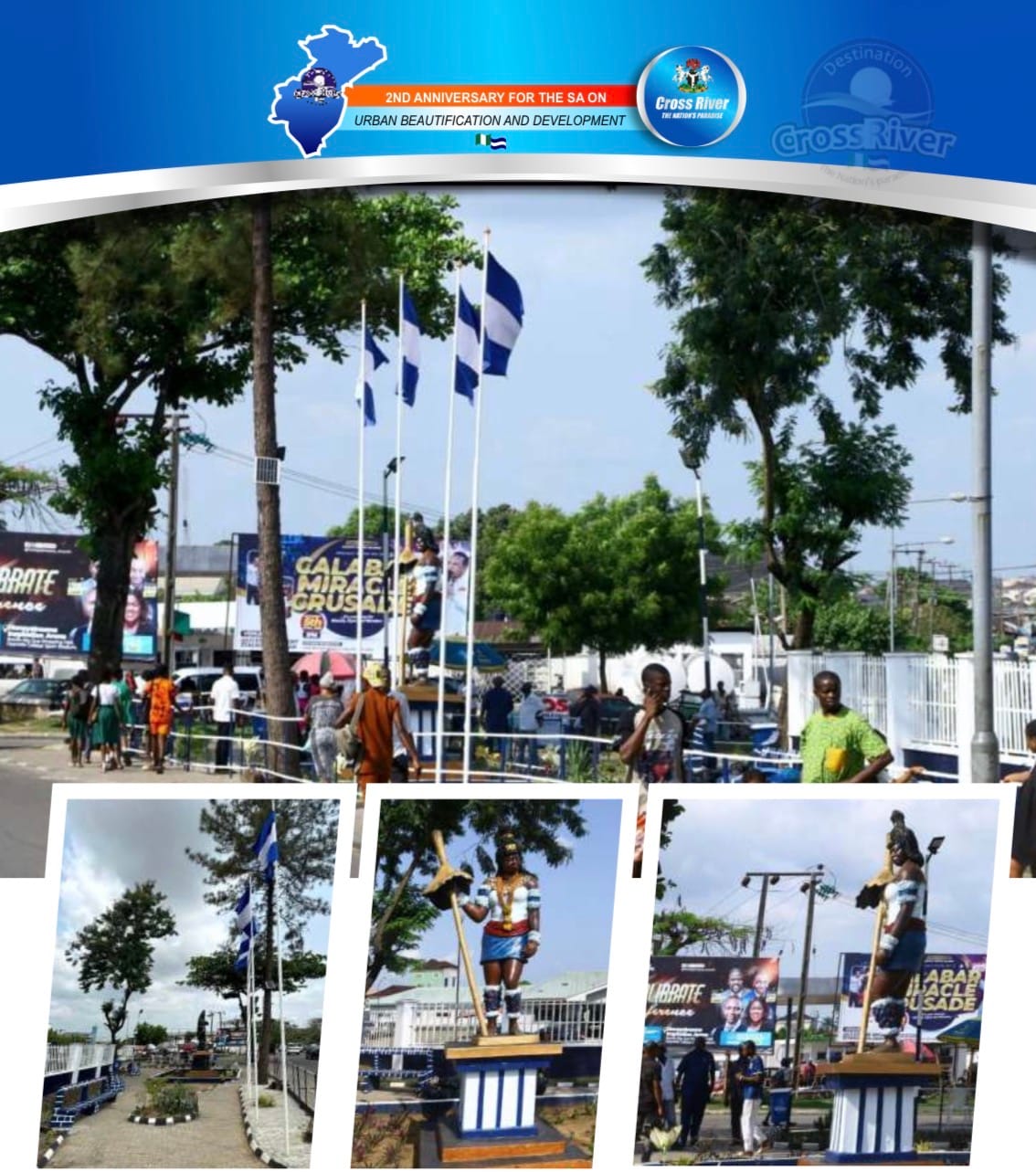
Landscaped lawns now replace previously occupied spaces. Decorative railings protect the green areas while guiding pedestrian movement. Newly installed blue-and-white benches provide commuters with comfortable waiting areas.
At the heart of the park, the iconic Moni Nkim statue, an enduring symbol of Ejagham cultural heritage, has received a befitting facelift, restoring dignity to one of Calabar’s important historical landmarks.
Today, the park once again serves as a functional transit hub, recreational centre and cultural attraction.
A New Face for Marian’s Pedestrian Gateway
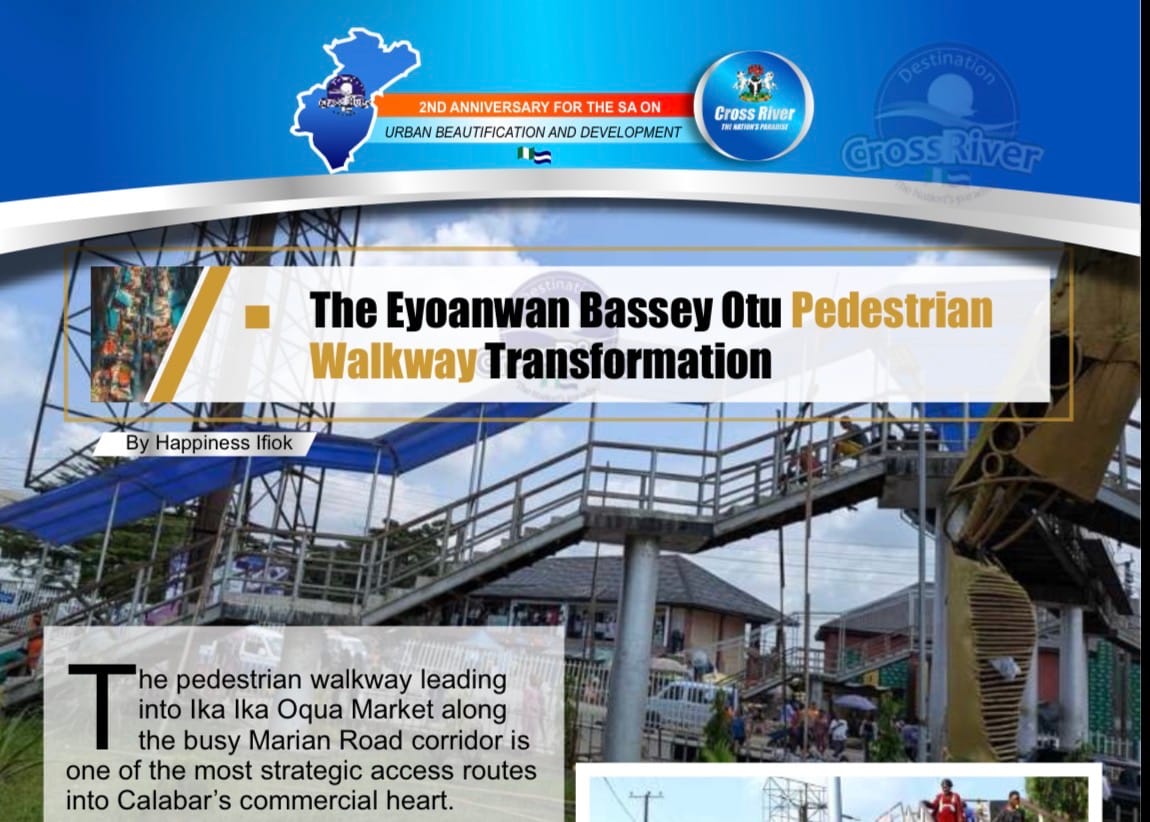
Another visible transformation can be found at the pedestrian bridge leading into Tinto Ika Ika Oqua Market along Marian Road.
Previously characterised by informal roadside businesses that obstructed movement and diminished the aesthetics of the environment, the area has undergone comprehensive redevelopment.
The green spaces beneath the bridge have been reclaimed and landscaped. The pedestrian walkway itself has been structurally reinforced, repainted and fitted with a distinctive blue canopy that provides shelter from sun and rain.
In recognition of Her Excellency, Bishop Eyoanwan Bassey Otu’s contributions to social development, the upgraded structure has been renamed the Eyoanwan Bassey Otu Pedestrian Walkway.
The intervention has significantly improved pedestrian safety while creating an attractive gateway into one of Calabar’s busiest commercial districts.
Planting Today for Tomorrow
Beautiful cities are also sustainable cities.
Recognising this, the Office partnered with Let’s Speak Africa to launch a tree and flower planting initiative along the Ekorinim II corridor.
The project saw the planting of more than 250 trees and ornamental flowers, introducing new green infrastructure into one of the city’s major road networks.
Beyond beautification, the initiative contributes to climate resilience by improving air quality, reducing urban heat, enhancing biodiversity and strengthening environmental sustainability.
Equally important was the active involvement of volunteers and environmental advocates, reinforcing the understanding that environmental protection is a shared civic responsibility.
Sweetness Park: Organising Commerce, Enhancing Beauty
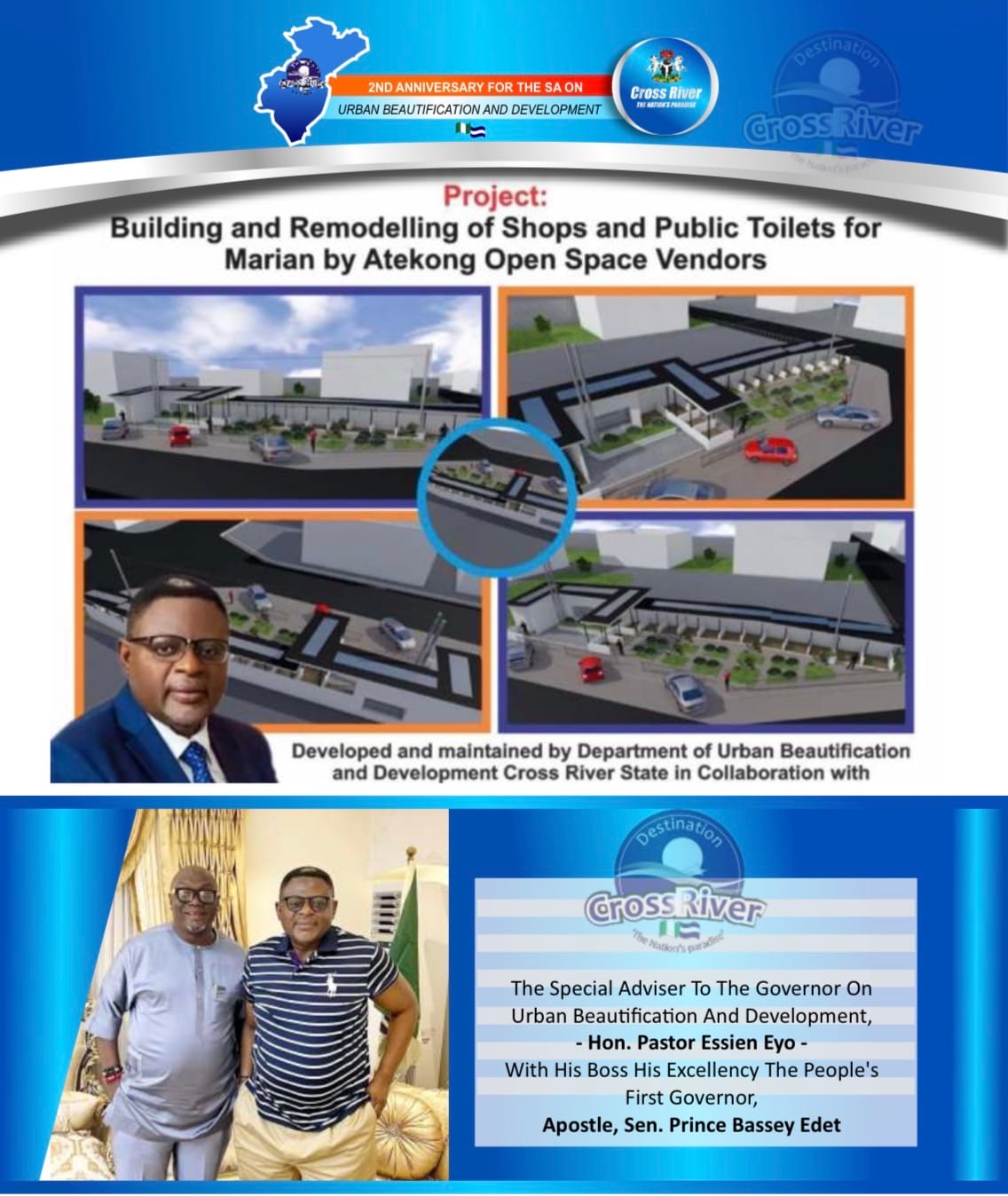
One of the office’s most ambitious ongoing projects is the development of Sweetness Park at Atekong Junction.
The Marian corridor remains one of Calabar’s busiest commercial districts, particularly at night when roadside businesses flourish.
While economically beneficial, years of uncontrolled expansion gradually reduced pedestrian space, created congestion and diminished the visual appeal of the environment.
Rather than displacing businesses, the Office adopted a more balanced approach.
The developing Sweetness Park will provide organised commercial spaces complete with sanitation facilities, improved drainage, CCTV surveillance and structured shop layouts.
Upon completion, the project is expected to decongest surrounding roads, improve pedestrian safety and preserve the area’s economic vibrancy within a cleaner, more organised environment.
It is a practical demonstration that urban renewal and economic growth can complement one another.
Beautification Beyond Infrastructure
The Office has also recognised that lasting environmental transformation cannot be achieved through physical projects alone.
Throughout the past two years, Hon. Pastor Essien Eyo has sustained an active public sensitisation campaign using the Cross River Broadcasting Corporation (CRBC), African Independent Television (AIT), Television Continental (TVC) and other media platforms to educate residents on environmental responsibility.
Working alongside the Special Adviser on General Duties, Hon. Ekpenyong Akiba, these engagements have consistently encouraged citizens to protect public infrastructure, maintain cleanliness and embrace responsible waste disposal practices.
The office also actively participated in the state’s World Environment Day activities organised by the Ministry of Environment, further reinforcing environmental advocacy and public participation.
The message has remained consistent: government may build beautiful spaces, but only citizens can preserve them.
Quiet Achievements, Visible Results
Urban transformation is often measured not by headlines but by everyday experiences, the cleaner streets people walk through, the parks families enjoy, the organised public spaces businesses thrive within, and the renewed civic pride communities embrace.
Over the past two years, the Office of the Special Adviser on Urban Beautification and Development has quietly demonstrated that meaningful change does not always require monumental projects. Sometimes, it begins with reclaiming neglected spaces, planting trees, restoring parks, improving pedestrian infrastructure, encouraging responsible waste disposal and inspiring citizens to take ownership of their environment.
These interventions align seamlessly with Governor Bassey Otu’s People First philosophy, which seeks to improve not only infrastructure but also the quality of life of Cross Riverians.
As the office looks ahead, its greatest achievement may not simply be the projects already completed, but the gradual restoration of a culture in which clean streets, green spaces and beautiful public environments once again become the collective responsibility and enduring pride of the people of Cross River State.