
The Cross River State Government has unveiled plans to strengthen agro-tourism and promote sustainable fisheries development as part of efforts to expand the state’s blue economy, boost local food production and reverse the declining fish population in rivers and streams.
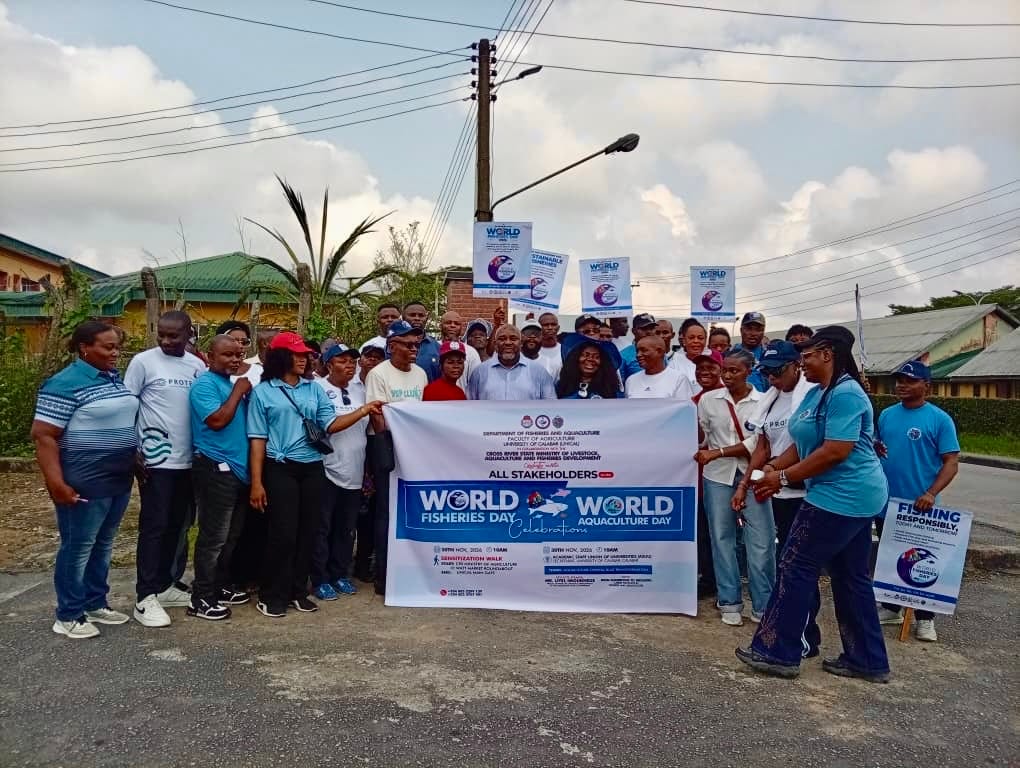
The plans were highlighted during the commemoration of World Fisheries Day, organised by the Cross River State Ministry of Livestock, Aquaculture and Fisheries Development in collaboration with the Faculty of Agriculture, University of Calabar (UNICAL).
The event featured a sensitisation road walk from the Ministry’s headquarters to the Faculty of Agriculture, UNICAL, bringing together government officials, academics, researchers, fish farmers, farmers’ associations and students to promote awareness of the economic, nutritional and environmental importance of fisheries.
Speaking at the event, the Special Adviser to the Governor on Livestock Development, Mr. Liyel Imoukhuede, commended the University of Calabar and its Department of Fisheries and Aquaculture for promoting awareness and encouraging stakeholder participation in the development of the fisheries sector.
Imoukhuede disclosed that the state government was exploring opportunities to develop agro-tourism around the livestock, aquaculture and fisheries value chains, noting that the sectors held considerable potential for economic growth, employment generation and tourism development.
He revealed that discussions were already underway with the Managing Director of the State Tourism Bureau to transform next year’s World Fisheries Day celebration from a departmental event into a state-backed festival. He also indicated plans to explore collaboration with the organisers of the Bakassi Fish Festival.
The Special Adviser encouraged residents to embrace household fish farming, explaining that small-scale aquaculture could serve as an additional source of income, improve household nutrition and contribute to the growth of the local economy. He also urged participants to celebrate the occasion by choosing fish over meat.
In his remarks, the Dean of the Faculty of Agriculture, Prof. Adekunle O. Johnson, stressed the importance of fisheries to human nutrition, environmental sustainability and economic development, expressing concern over the declining fishing activities in several local rivers and streams.
Drawing from his experience growing up in a fishing community, Johnson identified waterways around Igbouma Bana, Anyandama and the Cross River as areas where fishing activities had declined, calling for deliberate interventions to restock depleted water bodies and restore fish populations.
“My first degree was on the demand for fish in Calabar, and my PhD thesis was also on fish,” he said, explaining that his academic interest in fisheries had informed his consistent encouragement of students to undertake research on fisheries economics.
He disclosed that he encourages at least one student in every academic session to investigate issues relating to fish production and the relationship between fish importation and local supply. He added that his forthcoming inaugural lecture would also focus on fish, reaffirming the Faculty’s commitment to research that addresses practical challenges in the industry.
In her closing remarks, Prof. Oluwatosin O. Kennedy, who represented the organisers, appreciated the Ministry, the Farmers Association, the Faculty leadership and students for their participation and support. She described the World Fisheries Day celebration as a precursor to the forthcoming World Aquaculture Day on November 30, which will feature live fish exhibitions, fish species identification and culinary displays to educate and engage members of the public.








By Arit Ubi