
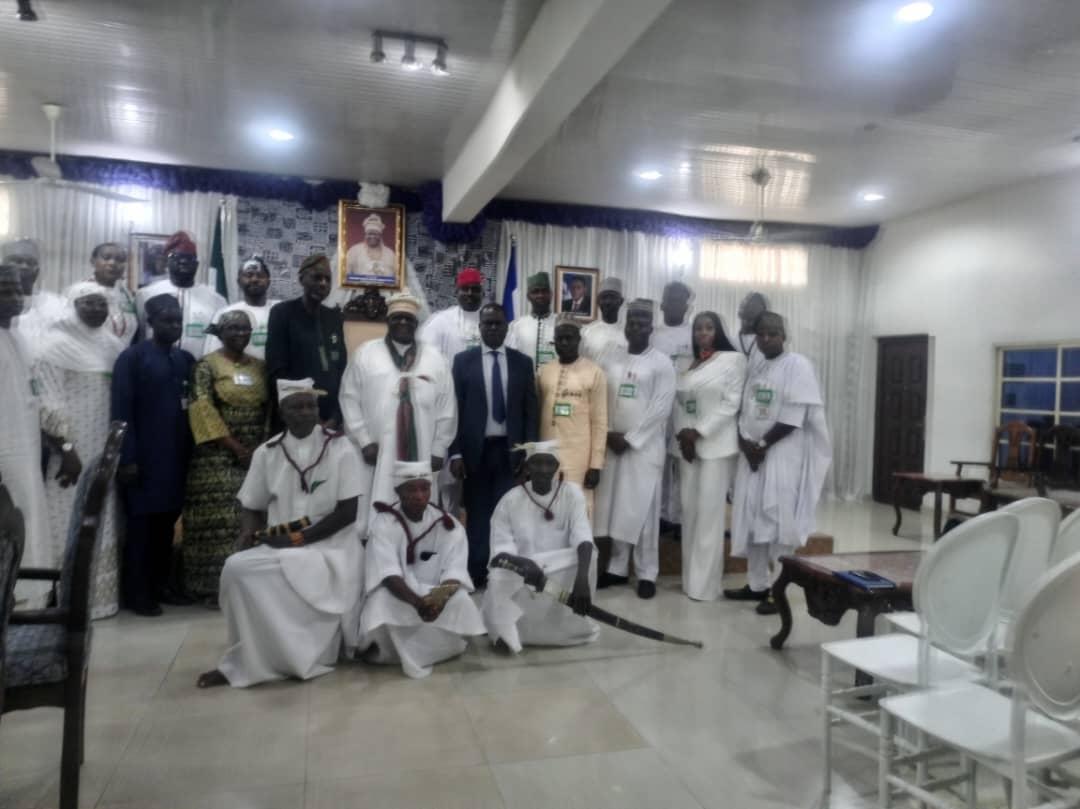
Participants of the National Institute for Policy and Strategic Studies (NIPSS) Senior Executive Course have visited the Palace of the Obong of Calabar, His Eminence Edidem Ekpo Okon Abasi Otu V, as part of their study tour of Cross River State. The engagement centred on cultural preservation, heritage promotion, and national development. The delegation—comprising senior government officials, representatives of Ministries, Departments and Agencies (MDAs), and other stakeholders—was led by the Secretary to the Cross River State Government, Rt. Hon. Owan Eno. The Ministry of Tourism, Arts and Culture, alongside other state institutions, was also represented. Welcoming the NIPSS team on behalf of the monarch and the Palace, His Highness Architect Eyo Ndem described the Institute as a vital national platform that convenes some of the country's finest minds to deliberate on critical national issues and shape policy for development. He noted that the inclusion of the Efik Kingdom in the study tour was a significant acknowledgment of the historical, cultural, and institutional relevance of the Efik people and their traditional heritage. According to him, the Efik Eburutu Kingdom boasts a history stretching over 600 years, with influence that once spanned the Cross River Basin, parts of present-day Akwa Ibom State, and territories extending into modern-day Cameroon and Equatorial Guinea. Architect Eyo further underscored the richness of Efik culture, highlighting its sophisticated governance systems, vibrant traditions, and indigenous methods of communication and knowledge transfer. He paid special attention to Nsibidi—an indigenous communication system based on signs, symbols, logographs, and pictographs—describing it as an integral part of the people's intellectual and cultural legacy. He expressed gratitude to the NIPSS delegation for choosing to visit the kingdom, stressing that such engagements foster a deeper appreciation of the histories and institutions that have shaped Cross River State and Nigeria. In his remarks, the NIPSS Director-General, Professor Ayo Omotayo (Department of Environmental and Sustainability Studies), commended the Obong and the Palace for their warm reception. He noted that the study tour offers participants practical insights into the historical, cultural, environmental, and developmental realities across the country—enriching their understanding of issues fundamental to national policy and strategic planning. The visit also facilitated robust interaction between the NIPSS participants, state government representatives, and the traditional institution, with discussions highlighting the need to preserve Nigeria's cultural heritage and harness it as a driver for sustainable development. A major highlight of the event was the presentation of a commemorative plaque to His Eminence and the Palace by the NIPSS delegation, in appreciation of the audience and the gracious hospitality extended to the participants. Overall, the study tour reaffirmed the value of collaboration between traditional institutions, government agencies, and policy think-tanks in advancing cultural preservation, knowledge exchange, and sustainable development—both in Cross River State and across Nigeria.
By Carolyn Ugbor