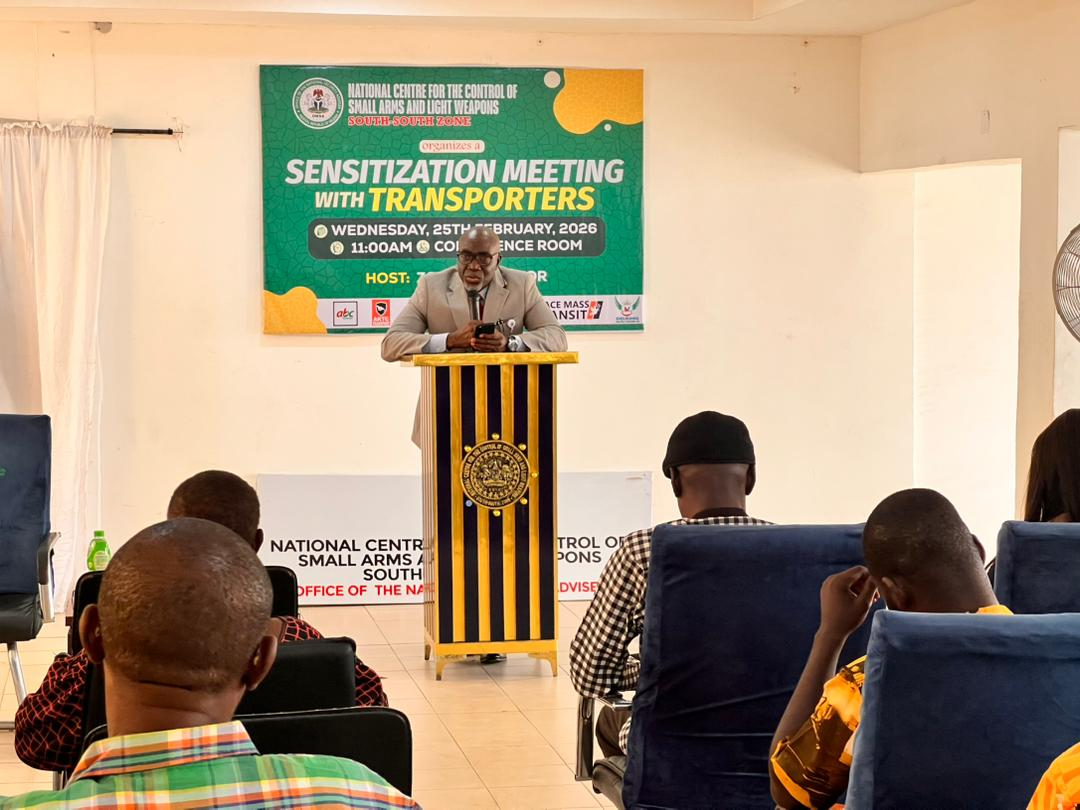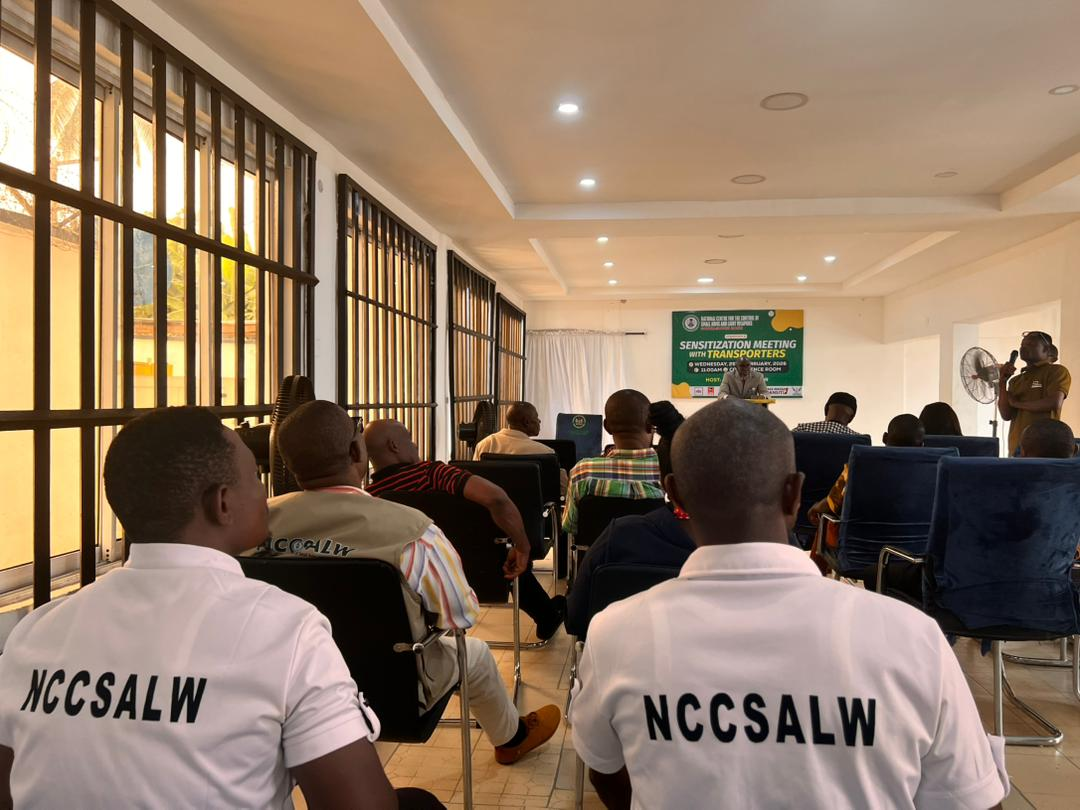
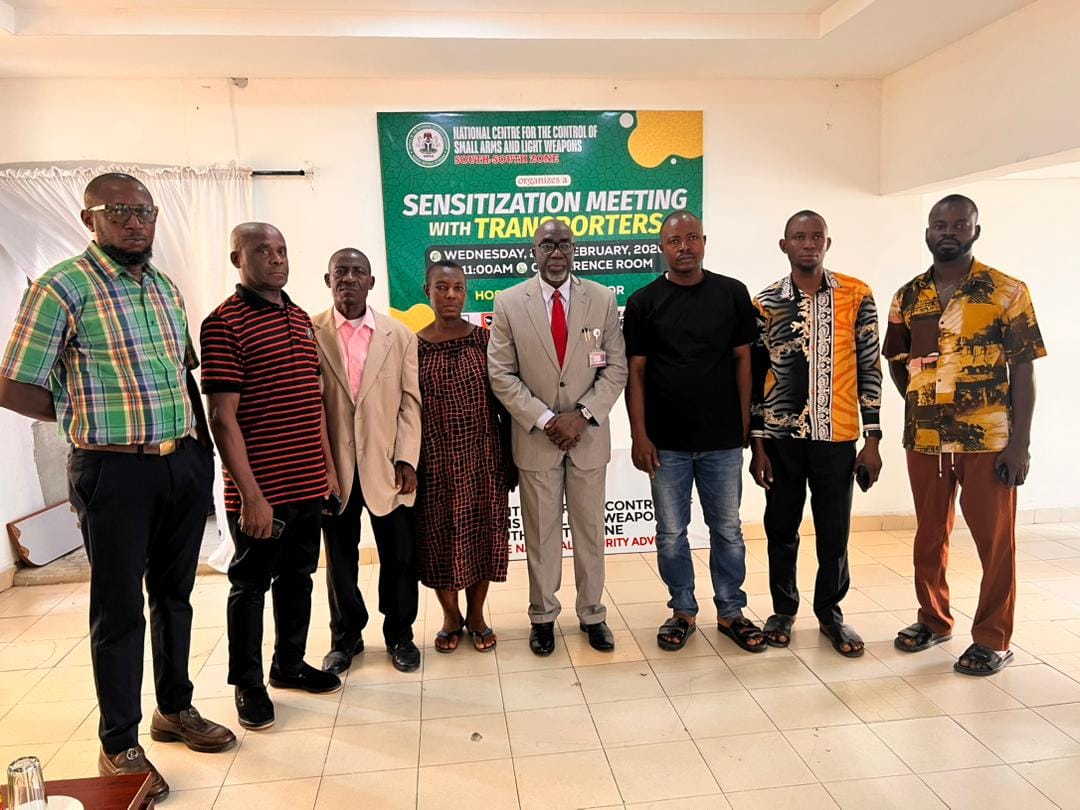
The South-South Zonal Office of the National Centre for the Control of Small Arms and Light Weapons (NCCSALW) has intensified its stakeholder engagement drive in Calabar, convening an interactive session with transport unions to strengthen collaboration against the proliferation of illicit small arms and light weapons in the region.
Addressing drivers and union leaders on Wednesday, the South-South Zonal Coordinator, Alex Inemah Ebimiebo, PhD., described transporters as indispensable partners in safeguarding communities. “Transporters are critical stakeholders that we need to work with. That is why we are here,” he said, adding that the session was aimed at building awareness and fostering cooperation.
Ebimiebo explained that the Centre was established on May 3, 2021, in line with Article 24 of the ECOWAS Convention on Small Arms and Light Weapons, and operates under the Office of the National Security Adviser. With its headquarters in Abuja and six zonal offices nationwide, he noted that the Calabar office serves as the South-South regional headquarters.
According to him, the creation of the Centre was informed by the rising level of insecurity fueled largely by the circulation of illegal firearms. “Without small arms, insecurity would not have been this widespread. You cannot carry out terrorism, armed robbery or violent conflict with bare hands; the main instrument is the gun,” he stressed.
He further pointed out that the challenge is not limited to Nigeria. “This is a global concern. Around the world, wherever you see mass violence and conflict, firearms are involved. That is why countries are taking deliberate steps to control arms proliferation,” he said.
Educating participants on the nature of small arms and light weapons, Ebimiebo listed conventional firearms such as AK-47 rifles, pump-action guns and pistols, alongside locally fabricated weapons. He emphasized that possession without a valid police license renders such firearms illegal under Nigerian law.
“When we talk about illicit arms, we are referring to weapons not obtained from authorized sources. In Nigeria, you must have a license issued by the police to legally possess a firearm,” he explained. “And an arm without ammunition is useless, so bullets and cartridges are also part of the proliferation problem.”
Expressing concern over the normalization of weapons in some communities, he observed that even non-security personnel have become familiar with firearms. He urged drivers to be vigilant, particularly when passengers attempt to offer inducements. “If someone is too eager to pay and discourages you from checking their load, you should suspect that something is wrong. Reject any form of inducement. You will be protecting yourself and society,” he warned.
The NCCSALW South-South Zonal Coordinator reaffirmed his organization’s commitment to deepening collaboration with transport unions, security agencies and communities to block the movement of illicit arms and promote an arms-free society across the South-South region and Nigeria at large.
Also speaking, the Zonal Legal Adviser, Barr. Endurance Asim-Ita, cautioned drivers about the legal consequences of conveying armed passengers. “If a passenger in your vehicle is found with illegal weapons, not only the park owner will be charged; the driver will also be charged,” she said.
“Ignorance is not an excuse,” she stressed. “In law, there are different parties to a crime, the person who commits the offence and the person who assists, whether knowingly or unknowingly. You may still be required to go to court and explain yourself.” She urged transport operators to think about their safety and future by refusing to be used as channels for illegal arms movement.
Barr. Asim-Ita also advised transport companies to institutionalize strict compliance measures. “Management must create policies to ensure that luggage and parcels are properly checked. You do not want anyone going to prison because of what was not verified,” she added.
Speaking for the organized transport sector, Mr. Ikechi Emmanuel of Cross Lines Company Limited welcomed the sensitization and affirmed that registered companies already enforce security protocols. “Registered companies are relatively compliant with security checks. The real danger comes from unregistered operators who pay less attention to passenger and luggage screening,” he said, noting that in his company, luggage inspection is mandatory and enforcement officers are stationed at loading points to checkmate heightened security concerns.
Emmanuel maintained that compliance is in every transport company’s best interest. “If anything happens in a vehicle, it is the company and the branch manager that will first be held responsible. So there is nothing wrong in insisting on checks,” he said, urging authorities to extend the sanitization drive to informal parks and unregulated operators.
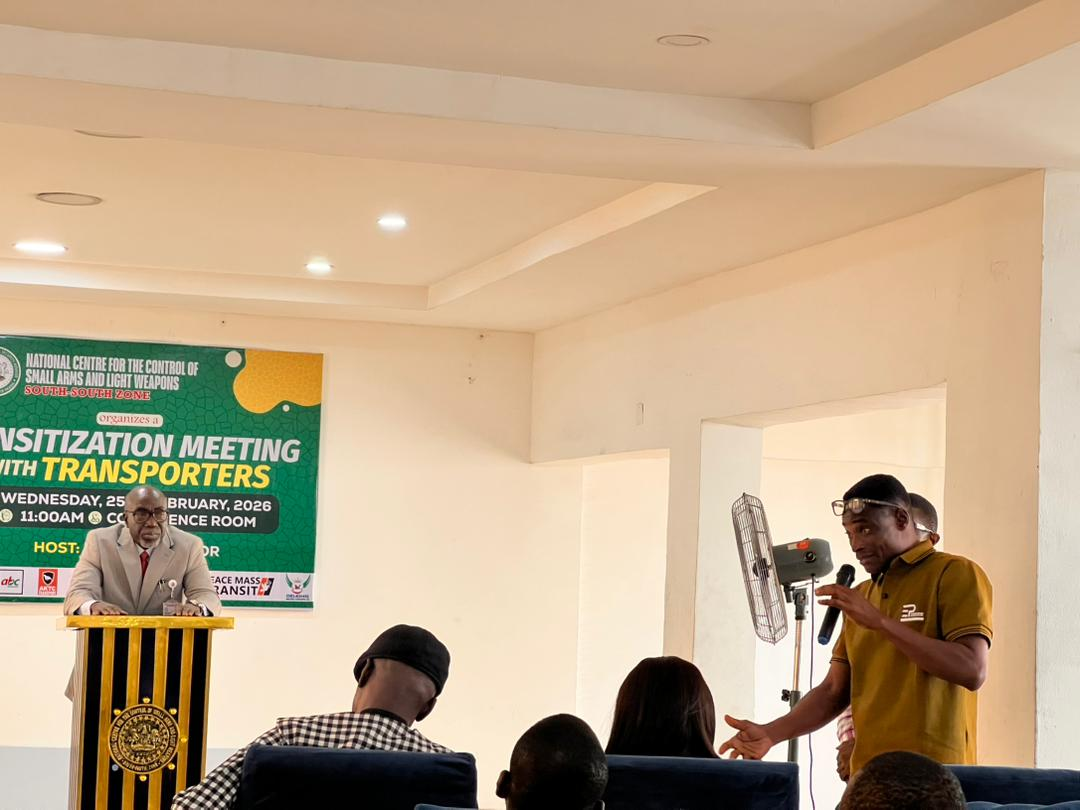
In their remarks, John Idorenyin of Akwa Ibom Transport Company and Ekpenyong Edet of the Unified Transport Union, Calabar, recounted their day-to-day experiences on the road, highlighting challenges and posing questions designed to make transport companies more vigilant and proactive in preventing the spread of illegal arms.