
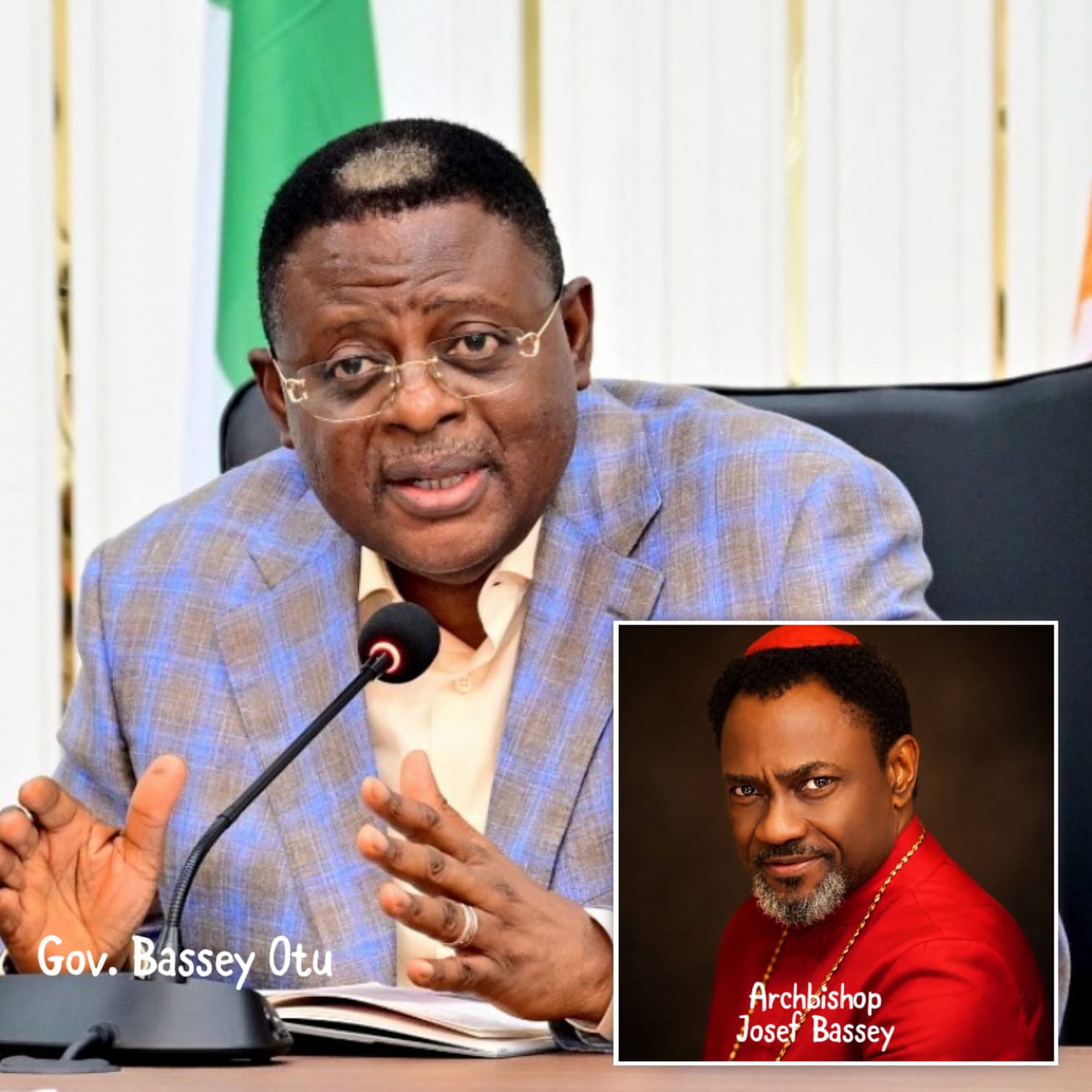
Territorial Archbishop of Calabar and Convener of the Cross River State Christian Leaders Forum, Archbishop Josef Bassey, has described Governor Bassey Edet Otu’s three years in office as “absolutely extraordinary”, declaring that Cross River State is recovering from the deep fiscal, institutional and infrastructural challenges inherited in 2023.
Archbishop Bassey made the assessment at a world press conference titled “The Evidence Before Us: A Statement on the State of Cross River and Our Common Future,” held on Wednesday, where he said his verdict was based on an examination of what the administration inherited, the resources available to it, accumulated liabilities, debt, revenue, infrastructure, asset recovery and emerging economic initiatives.
He recalled that Cross River was handed over in May 2023 with a domestic debt of approximately N204.05 billion, substantial foreign-denominated obligations, accumulated workers’ and pension liabilities, promotion arrears and unpaid gratuities, while several public institutions and government assets had suffered years of deterioration. “We were in a deep pit. All the accounts of the state were in red with heavy debts on them,” he said.
The Archbishop, however, noted that the state’s domestic debt had declined to approximately N137.36 billion by December 2025 and N132.30 billion by March 2026, representing a reduction of about N71.7 billion from the June 2023 figure. He said the reduction was particularly significant given Cross River’s relatively limited fiscal resources and the difficult economic conditions under which the administration had operated.
He also pointed to growth in the state’s internally generated revenue, noting that National Bureau of Statistics figures put Cross River’s IGR at approximately N21.1 billion in 2022 and N31.56 billion in 2023, while state fiscal records subsequently reported about N46.3 billion in independent revenue for 2024. Bassey said the simultaneous rise in revenue capacity and decline in domestic debt was evidence of a positive fiscal direction, although he cautioned that the state still carried substantial external obligations of about $223 million as of the end of 2025.
The Clergyman particularly commended the recovery of Tinapa, describing it as an important asset of the state that had been lost to the Asset Management Corporation of Nigeria (AMCON) but was now back under Cross River’s control. He, however, stressed that the facility must be made economically productive, warning that “recovery alone is not enough. Tinapa must now work.”
He also highlighted the reconstruction and rehabilitation of major public assets, including the Governor’s Office, State Library, Cultural Centre Complex, government lodges, Local Government Service Commission and CICC facilities. According to him, restoring deteriorated public infrastructure may offer less political visibility than building new projects, but remains critical to recovering the state’s institutional inheritance.
On workers’ welfare, the Archbishop acknowledged progress in addressing inherited gratuity obligations, noting that no gratuity had been paid between 2009 and 2023, while payments had now been made up to 2015. He also commended efforts to rebuild the civil service through recruitment, promotions, training and digitisation, while stressing the need to restore merit, professionalism, institutional discipline and competence.
Bassey said the administration’s emerging economic architecture, particularly initiatives in cocoa, coffee and oil palm, Project Grow, the Bakassi Deep Seaport, tourism and aviation infrastructure, as well as efforts to pursue Cross River’s maritime and petroleum rights, could provide the foundation for sustained economic growth. He stressed that the deep seaport remained unfinished but said the technical studies, regulatory processes, investment mobilisation, financing initiatives and evacuation-corridor planning were important steps that must now lead to execution.
He urged the government to move beyond recovery into aggressive development, noting that resources currently being expended on rebuilding collapsed institutions and settling inherited liabilities could eventually be redirected towards industries, innovation, education, healthcare and enterprise. According to him, “We have spent three years buying back our past. Now, we must build our future.”
The Archbishop, however, called for a stronger government team as the administration enters its next phase, warning that some appointees lacked the competence and capacity required to translate the Governor’s vision into measurable results. He urged Governor Otu to prioritise character, competence, capacity, track record and execution in making strategic appointments, rather than political considerations.
Bassey also commended Governor Otu for publicly identifying with God and dedicating Cross River State to God, saying this should translate into higher standards of justice, integrity, righteousness and responsible stewardship. He stressed that such a position did not exempt government from scrutiny but should strengthen its obligation to serve the people faithfully.
Declaring that his loyalty was to Cross River State rather than any government or political party, Bassey said he had applied the same standard to the Otu administration that he had applied to previous governments. “Where government fails, I will speak. Where government succeeds, I will acknowledge it. Where government must do more, I will demand it,” he said, adding that measured against what was inherited, the resources available and the prevailing economic circumstances, Otu’s three-year record was “absolutely extraordinary” and Cross River was steadily recovering.