
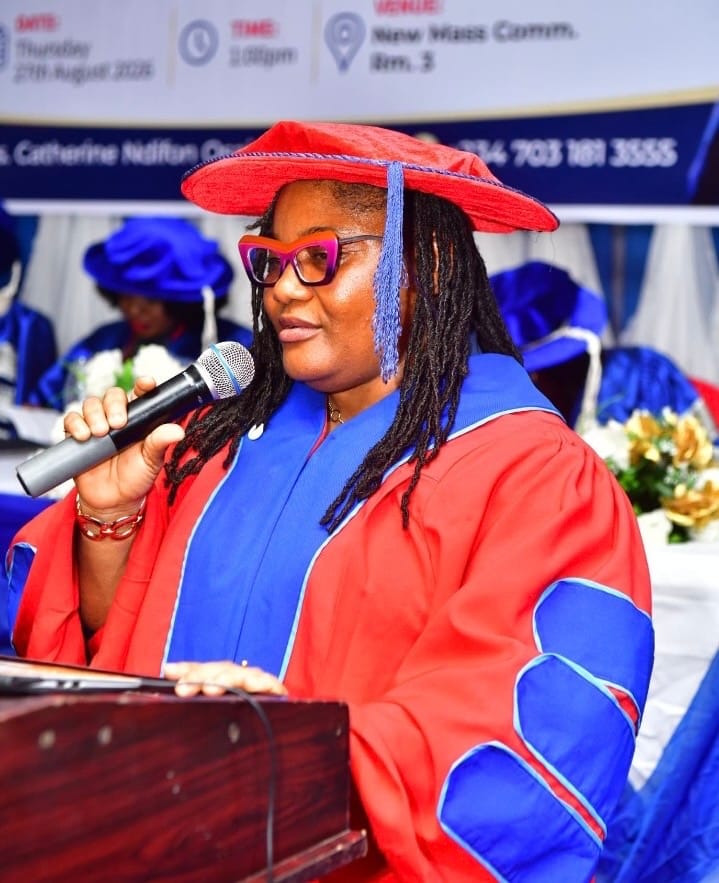
What holds a society together when its institutions are tested, its values challenged and its people confronted by rapid change? For Professor of Genetics and Biotechnology at the University of Cross River State (UNICROSS), Prof. Hannah Edim Etta, part of the answer lies in understanding the science of connection, beginning with the molecular architecture of Deoxyribonucleic Acid (DNA).
Prof. Etta advanced this compelling thesis while delivering the University’s 12th Inaugural Lecture on Thursday, August 27, 2026, titled “Links, Linkages and the Missing Link: From DNA Backbones to Social Cohesion.” The lecture provided an interdisciplinary exploration of how the principles governing biological systems could illuminate the relationships that sustain human societies.
Using the DNA backbone as her scientific point of departure, the don explained that biological life is sustained by intricate linkages between constituent components. These connections provide the stability and continuity necessary for genetic information to be preserved and transmitted, a principle she argued has a striking parallel in the organisation of society.
According to her, just as the integrity of DNA depends on the strength and interaction of its molecular components, the resilience of society rests on the quality of relationships among individuals, institutions, values and social structures. Weak links, she suggested, can compromise the functionality of an otherwise complex system.
Prof. Etta deepened the argument by examining fundamental genetic concepts such as heredity, mutation, adaptation and genetic diversity, demonstrating how they offer useful conceptual lenses for understanding continuity, transformation and adaptation within society. In this sense, biology becomes more than a study of life at the molecular level; it becomes a framework for reflecting on human development.
Beyond the conceptual parallels, the inaugural lecturer examined biotechnology as a practical instrument for transforming society. She highlighted its enormous potential in agriculture, food security, healthcare and economic development, while advocating wider access to scientific knowledge and biotechnology.
She identified the bioeconomy as a particularly important frontier for sustainable development, urging society to harness scientific discoveries and technological innovations in ways that expand opportunity, improve livelihoods and ensure that the benefits of knowledge are not confined to a privileged few.
At the heart of her lecture was the proposition that the strength of a system is inseparable from the integrity of the links that hold it together. Prof. Etta therefore called for stronger social relationships, functional institutions and shared values, arguing that these are not peripheral considerations but fundamental infrastructure for a cohesive and resilient society.
The lecture also demonstrated the value of interdisciplinary scholarship, bringing together genetics, biotechnology, sociology and development discourse to show how knowledge generated in the laboratory can offer fresh perspectives on some of society’s most enduring challenges.
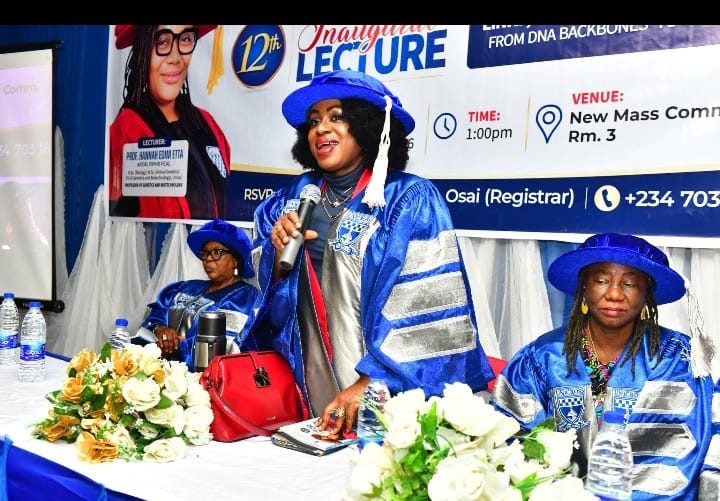
In her remarks, the Vice-Chancellor of UNICROSS, Prof. Francisca Bassey, described Prof. Etta as one of her dedicated students who had distinguished herself through diligence, commitment and professional excellence. She welcomed members of the University Governing Council, academics, management, staff, students and invited guests, and commended the inaugural lecturer for her scholarly contribution.
Presenting the citation, Prof. (Mrs.) Robito S. Ekanem of the Department of Guidance and Counselling, UNICROSS, chronicled Prof. Etta’s distinguished academic and professional career, including her service as Director of Academic Planning of the University.
By Kingsley Agim